Five Observations from Accompanying the SuperAI Team in Hangzhou and Shanghai
A field note from visits to universities, open-source communities, and AI companies in Hangzhou and Shanghai, and what those conversations revealed about cross-border technology exchange.
Last week, SuperAI co-founder Peter and the ecosystem team came to China at the invitation of WAVE, an initiative started by Guohao. I accompanied them through Hangzhou and Shanghai. Over several days, we visited Zhejiang University, ModelScope, Qwen, Qoder, Datawhale, ZhenFund, MiniMax, Volcano Engine, Trae, and SenseTime.
The team came with two practical goals: to understand China's AI ecosystem more systematically and to invite relevant Chinese teams to SuperAI in Singapore that June. As we moved from one conversation to the next, I realized that the more useful thing to record was not the itinerary, but where each side's understanding of the other still broke down.
The five observations below are not conclusions. They are simply the questions that kept returning during the visit.

A conference is becoming a year-round ecosystem
One thing became clear during the visit: meeting once a year is not enough.
If a conference only appears for a few days each year, relationships weaken in the months between editions. Speakers, founders, investors, community operators, and partners return to their daily work. Without ongoing visits, content, smaller gatherings, and shared questions, trust has to be rebuilt every year.
That is why SuperAI has developed a dedicated ecosystem team. The conference remains a high point, but the work increasingly happens throughout the year: meeting partners, understanding local contexts, creating smaller conversations, and identifying knowledge worth bringing to the larger stage.
A summit is one moment in a relationship that has to continue before and after it.
During the visit, I told Peter that Singapore occupies a distinctive position in global technology exchange. It can connect China with Western ecosystems without reducing every interaction to a geopolitical frame. There is still no major stage where leading Chinese model companies regularly sit alongside organizations such as OpenAI and Anthropic for a serious technical and industry conversation.
His answer was simple: Let's make it happen.
Global teams are curious about China, but the entry points are weak
It would be wrong to assume that international technology communities are not interested in China. The opposite is often true.
Global founders and ecosystem teams are curious about Chinese models, robotics, hardware, developer communities, and the speed at which technologies become part of everyday environments. At SenseTime, the team saw a retail robot complete a purchase flow: after payment, it collected an item and delivered it to the customer. They immediately wondered whether something similar could be brought to the conference.
For people working inside China, the combination of robotics, mobile payment, automated retail, and offline services may not feel unusual. For overseas visitors, the combination itself can be the insight.
That is one of the most important characteristics of China's technology ecosystem. Its advantage is not always a single breakthrough. It is often the way multiple capabilities—hardware, supply chains, software, payment infrastructure, and dense real-world scenarios—combine into something visible and usable.
These combinations are not always legible from outside China.
There is also a gap between domestic attention and international visibility. A company discussed constantly in China may be barely visible abroad, while another company may have stronger international recognition than its domestic popularity would suggest.
Technical strength matters, of course. DeepSeek became globally recognizable because the product and technical signal were strong. But sustained international visibility also depends on whether a company keeps appearing in global conversations, contributes knowledge, and explains its work in language that international builders can interpret.
This is not the same as translating Chinese marketing material into English. It requires translating context: why a technical path was chosen, what local users are doing, how a supply chain changes product decisions, and which parts of the Chinese market experience might matter elsewhere.
What global audiences want to hear from Chinese companies
SuperAI was not simply looking for Chinese companies willing to promote themselves.
The team wanted knowledge: technical judgment, industry insight, real application patterns, and an honest view of how products are being built and commercialized in China.
Companies often approach an international conference as a branding opportunity: a booth, a keynote, a product announcement, or a round of business development. Those things can be useful, but they rarely create lasting influence by themselves.
The stronger contribution is an explanation that helps the room understand something it could not see before:
- Why is this technical route emerging in China?
- What are Chinese users doing differently?
- How do hardware, developer ecosystems, and supply chains change the speed of iteration?
- What has a company learned from deploying AI in real operating environments?
- Which assumptions from other markets do not hold here?
Chinese technology companies entering global ecosystems should not only bring products. They should bring their understanding of the industry.
To be globally understood, it is not enough to appear in someone else's report, ranking, or news story. Chinese builders also need to participate in defining the questions.
Neutral spaces make technical conversations easier
Many of the companies we spoke with wanted to join international conversations without first being defined by a national label.
When every exchange is interpreted through a larger political narrative, potential partners can become cautious before they have understood the product, technology, or practical value. A more neutral environment allows the conversation to begin elsewhere: with engineering choices, user needs, industry experience, and possible collaboration.
This is part of Singapore's value. It can create a space where people from different countries and systems meet around technology and industry first. Neutrality does not remove context, but it can make room for a more precise conversation.
What should remain after a field visit
The SuperAI visit reinforced something I have learned through Datawhale, AGI Villa, and other community work: global ecosystem connection is moving from occasional contact toward continuous relationships.
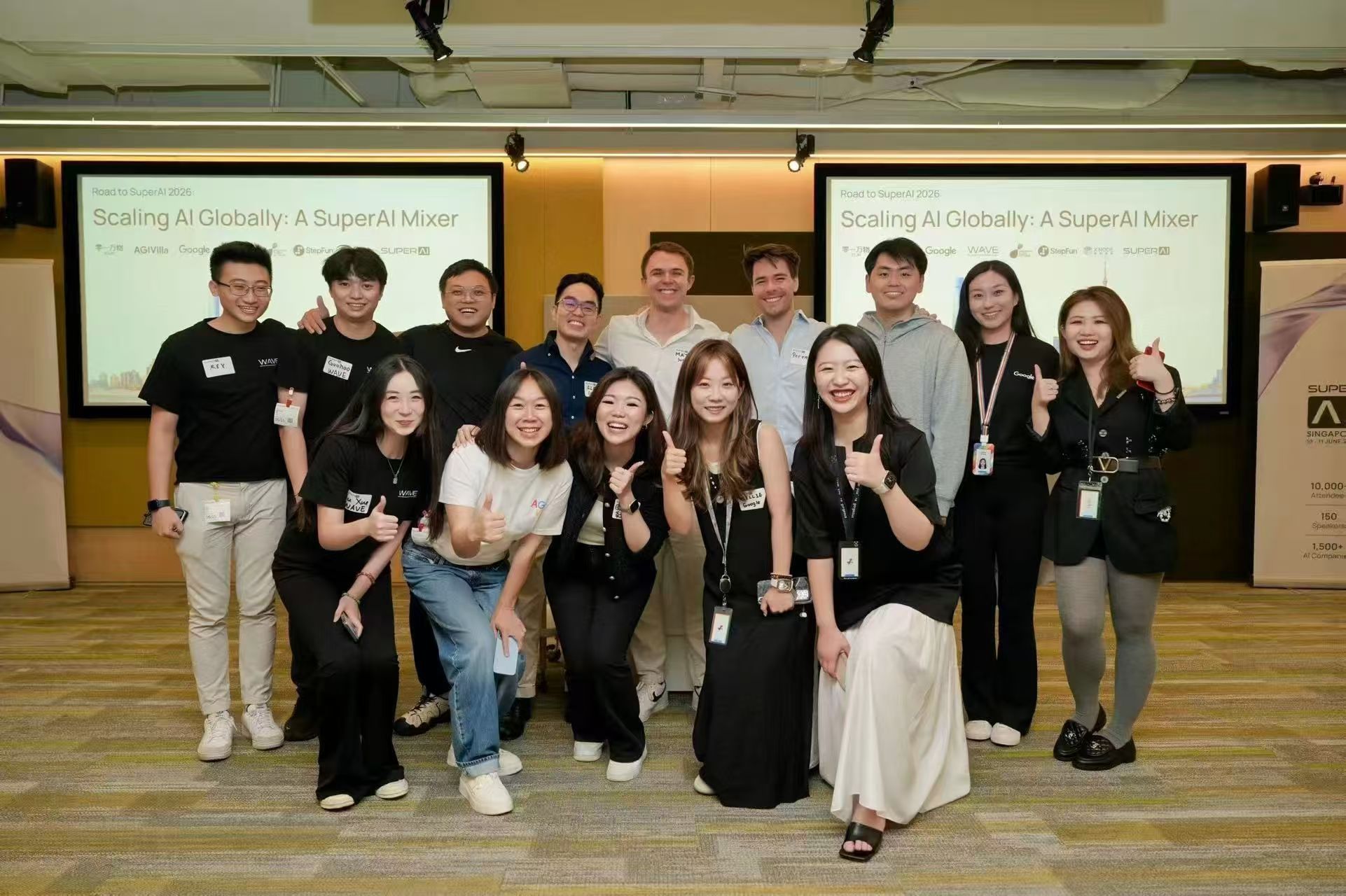
A useful China visit is not a list of famous companies. It should help a visiting team understand why different parts of the ecosystem matter, how they relate to one another, and which conversations deserve a next step.
For a conference or overseas technology organization, that might mean:
- meeting builders before inviting speakers;
- learning which Chinese topics can contribute real knowledge to a global stage;
- maintaining smaller conversations between annual events;
- returning with clearer questions rather than only photos and introductions;
- building enough trust that partners can speak honestly about what is working and what is not.
For Chinese companies, the same relationship works in reverse. Participating in the global ecosystem is not one overseas speech or one conference ticket. It means showing up consistently, explaining the context behind the product, contributing knowledge, and continuing the conversation after the event.
Datawhale has spent years connecting AI learners, developers, universities, companies, and local practice across China. The next step is to place more of that work in a global context: helping international partners see what Chinese developers and builders are actually creating, while helping Chinese communities form durable connections with peers abroad.
The work ahead has two directions:
- support more overseas Datawhale city nodes and long-term relationships with local developers, founders, universities, and communities;
- continue bringing global ecosystem partners into China so they can experience companies, developer communities, industry environments, and city-level innovation directly.
These relationships take time. They grow through repeated visits, careful translation, and conversations that continue after everyone goes home.
If you organize an AI community or developer event outside China, or want to understand China's AI ecosystem more closely, feel free to write. I will keep recording what happens in these visits and collaborations.