How Can Personal Experience Become an Asset in the AI Era?
A conversation with Bai Shuang, CEO of Leapility, about expert agents, drawing out tacit knowledge, turning personal judgment into a repeatable product, and building a business around value you want to create over the long term.
English translation of the Chinese original.
Recently, I spoke with Bai Shuang, CEO of Leapility, about expert agents. We began with what seemed like a technical question: what exactly distinguishes a general-purpose agent from an expert agent?
As the conversation went on, though, another question emerged—one that matters to far more people:
In the AI era, can the experience, methods, and judgment a person has accumulated become more than something that exists only in their head? Can they become an asset that keeps working, keeps delivering value, and perhaps keeps generating income?
This may also be the central question behind OPCs, one-person companies, and the future of individual entrepreneurship.
Beyond General-Purpose Agents, a More Fragmented Market
When people talk about agents today, they often think first of the companies building large models. Models are becoming more capable, tool use is expanding, and agents can handle increasingly complex tasks.
This market naturally tends toward concentration. It depends on models, computing power, data, and infrastructure, and a small number of large companies may ultimately hold most of the market.
For most of us, our role in this market is primarily that of a consumer: buying access to models, using agents, and paying for tokens and subscriptions.
But Bai believes that beyond general-purpose agents lies another market: a much longer tail of more specialized needs. It is driven by individual people rather than model companies. A doctor, lawyer, consultant, designer, entrepreneur, or someone who has spent years working in a very narrow field may have experience and judgment that a general-purpose model cannot fully replace.
That expertise may come from years of practice, or from intuition developed through repeated failures. In the past, people could share it only through consulting, training, or services. In the future, they may be able to encapsulate it in expert agents.
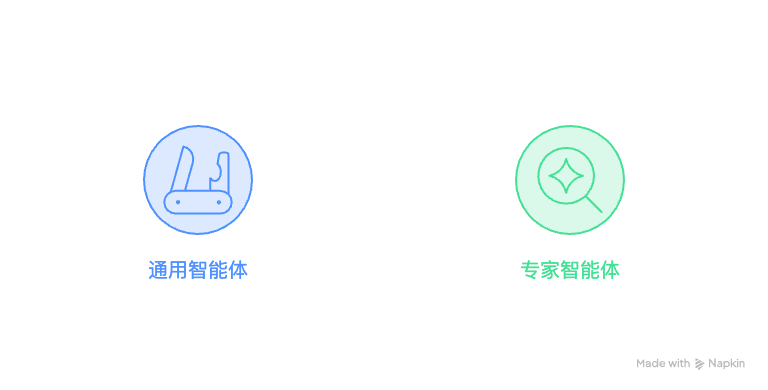
A general-purpose agent is more like a Swiss Army knife. It can do a little of everything, but it struggles to be sufficiently good in every professional setting.
Precise, complex work that calls for experienced judgment still needs experts. The difference is that where people once searched for an expert, they may in the future search for an agent built from an expert's experience.
What Experts Really Possess Is Not Just Knowledge, but Know-How
Knowledge is not scarce. There are already plenty of books, courses, papers, and public sources, and large models can quickly retrieve and organize them. What is scarce is know-how: how someone makes judgments, weighs tradeoffs, breaks down a problem, and decides which method to use in which circumstances.
Many experts do not even recognize the value of this knowledge. Certain judgments have become common sense to them. But for someone who has not gone through the same experiences, that “common sense” is precisely what is most valuable. So the hardest part of building an expert agent is not simply writing a prompt or setting up a workflow. It is this:
How do you draw out the tacit knowledge in a person's mind?
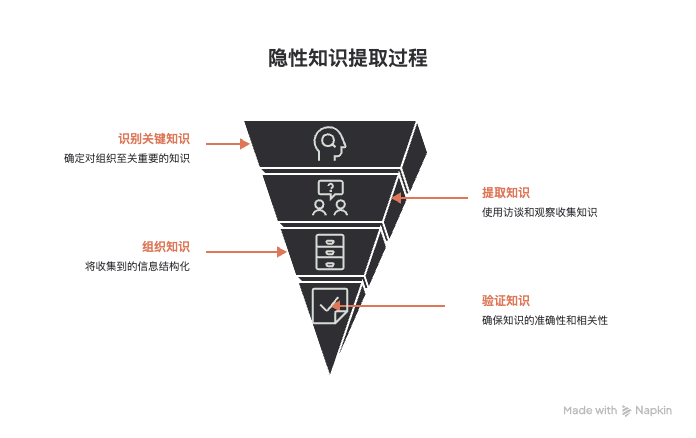
One approach is to import the articles someone has written, the courses they have taught, and the material they have shared, then let AI organize it into a structured form.
Another is to use ongoing, in-depth conversations to gradually uncover how an expert thinks through a particular type of problem.
A third is to record the judgments experts naturally make while working, consulting, and talking with others, continuously feeding that material into their digital counterparts.
Building an asset from expertise does not have to start with a complete methodology. Often, it can start with just one question:
What do other people most often come to you to ask about?
That question often provides the first clue to your distinctive value.
A Real OPC Is Not About Doing Every Job Yourself
OPC has become a popular term over the past two years. Many people understand it this way: with AI, one person can now do work that used to require ten. But that is not the core value of an OPC.
Bai brought up two words:
Solo and Scalable.
Solo means that one person or a very small team does the work. Scalable means that the business can be replicated at scale.
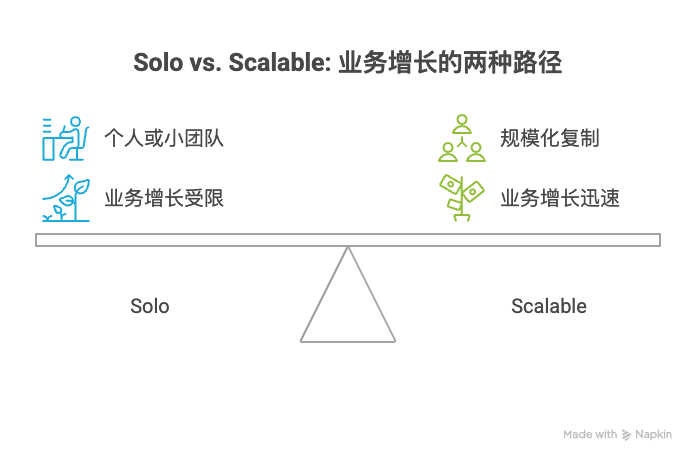
Many people use AI to become more efficient, shortening a two-month project to two weeks or even two days. But if every additional client still requires another investment of their time, the business model has not fundamentally changed. They are still selling their time.
A real OPC is about more than efficiency. It is about turning personal experience into a product.
Only when someone's experience can be called upon and delivered repeatedly, without depending entirely on their real-time participation, does scaling become possible. From this perspective, an expert agent is more than an extra tool. It may be an OPC's most important asset.
In the past, an expert could serve only a few people each day. In the future, their agent could serve dozens, hundreds, or more users at once. The expert could continue learning, making judgments, and creating, instead of having their time consumed by repetitive delivery work.
Personal Value Goes Through Three Transformations
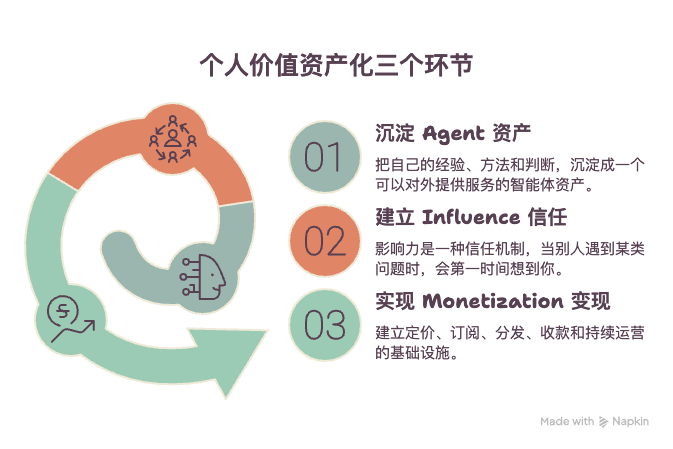
During our conversation, Bai introduced an AIM model. As I understand it, the model describes three stages in turning personal value into an asset.
- First, Agent: turn your experience, methods, and judgment into an agent asset that can provide services to others.
- Second, Influence: even excellent expertise needs to be seen. Influence does not necessarily mean becoming an internet personality with a huge following. It is more like a mechanism for trust: when someone encounters a particular kind of problem, do they think of you first?
- Third, Monetization: once expertise and influence are established, you still need infrastructure for pricing, subscriptions, distribution, payments, and ongoing operations.
In the past, an expert had to build a website, set up payments, handle marketing, and deliver the service themselves. In the future, platforms and agents may take over these tasks. The expert's real responsibility will be to keep learning and improving the quality of their professional judgment.
This also suggests that new roles may emerge around expert agents. Some people will discover experts; others will help them articulate their methods or build personal brands. Still others will combine multiple expert agents into industry solutions. This may become more than a relationship between one person and one AI. It could gradually form a network of experts, agents, intermediaries, and service platforms.
In the AI Era, Efficiency Is Not the Ultimate Competitive Advantage
AI will make more and more capabilities widely available. Writing copy, creating images, writing code, and performing analysis will all become cheaper. When everyone has access to similar models and tools, simply knowing how to use AI is unlikely to provide a lasting competitive advantage.
The question that really matters is:
What value can you offer beyond what a large model provides?
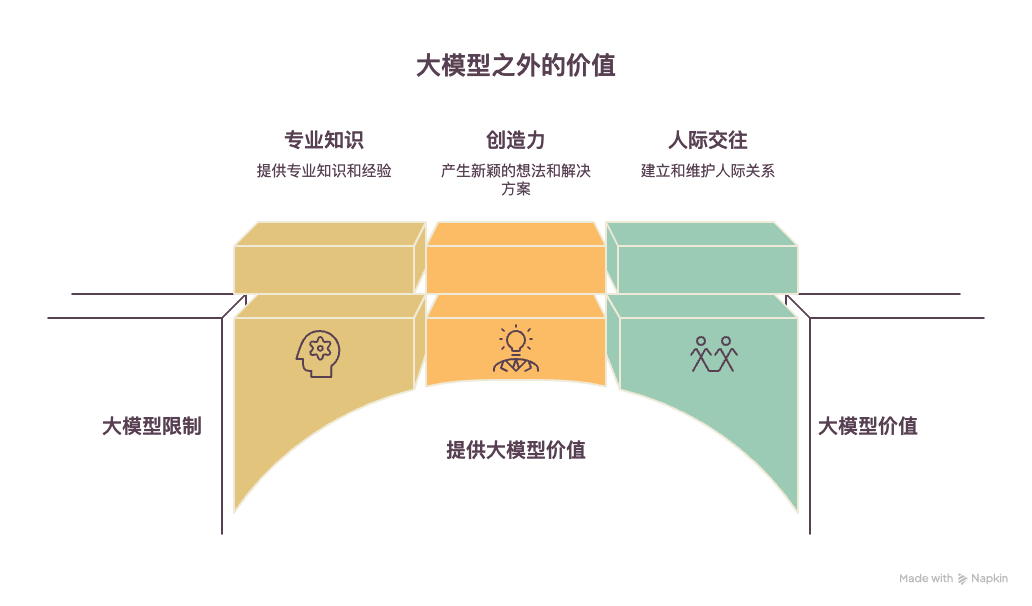
That value may come from years of deep practice, distinctive experiences, aesthetic sensibility, a particular way of making judgments, or a combination of different fields. It is hard to copy and will not disappear with a single model update. In that sense, the AI era asks us to become more distinctive as individuals.
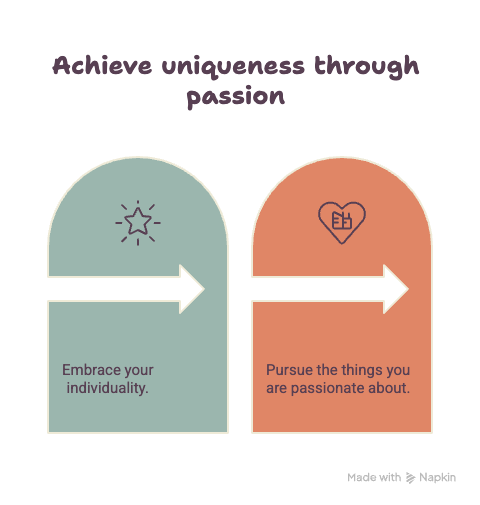
The point is not to be different for its own sake. It is to find something you are willing to invest in, learn about, and create for over the long term. Only sustained commitment can produce experience beyond what exists in a model's training data. And it is that experience that may become an asset that truly belongs to you.
Entrepreneurship Should Return to Value Itself
Toward the end of our conversation, we talked about entrepreneurship. AI has brought many new opportunities, but it has also created plenty of anxiety. Some people start AI businesses because they fear missing the next wave. Others keep chasing new models, platforms, and concepts. But when a venture is driven solely by trends and fear, it is difficult to sustain it through the long uncertainty of building a business.
What can sustain someone over the long term may still come down to a few simple questions:
- What do you really want to do?
- Whom are you willing to serve over the long term?
- What real problem can you solve?
- What distinctive value can you offer the world?
Entrepreneurship does not necessarily mean building a vast company. It can also mean a mature method, an expert agent that keeps working, a group of users who truly trust you, and a personal asset that no longer depends entirely on selling your time. Perhaps AI's most important contribution is not to turn people into more efficient tools. It is to free us from instrumental work, giving us more time to learn, create, and become ourselves.
In the future, everyone may have an agent. But what determines its value will still be more than the strength of its model. It will be the experience and judgment of the person behind it—and whom that person chooses to create value for.
Be unique. Do what you love!
This article was adapted from the author's original mdnice draft, with adjustments to heading levels and paragraph formatting. Read the original WeChat article.